

Claneo SEO Study
Search Study 2025: Insights into How Germans Search
Claneo SEO Study


For decades, “googling” has been the umbrella term for searching online. If you are looking for something, you google it. But is that still true? Our SEO Study 2025 offers fascinating insights into how people in Germany search!
In recent years, new platforms such as AI chatbots and new social media platforms have fundamentally changed how people search online. “Googling” is still the common term for online search, but it is far from the only option.
Our Search Study 2025 offers fascinating insights into this development. Together with the market research platform Appinio, we surveyed 2,000 people in Germany (results on this landing page) and the US (Search Study US) to find out how search behavior has changed and which platforms people prefer for which purposes.
We wanted to know:
The results show: Search behavior is becoming more specialized, AI solutions are rapidly gaining importance and trust, and the choice of platform depends heavily on the search need and the target group. Our study delivers valuable insights for anyone who wants to understand how people search for information, products and brands online in 2025.


Frequency of use across platforms: AI gains users, Google still dominant
Search engines like Google remain the dominant platforms for online search. 77% of respondents use them several times a week (2024: 81%). At the same time, AI chatbots like ChatGPT show remarkable growth: their use rose by 15 percentage points to 33% (2025) compared to the previous year.
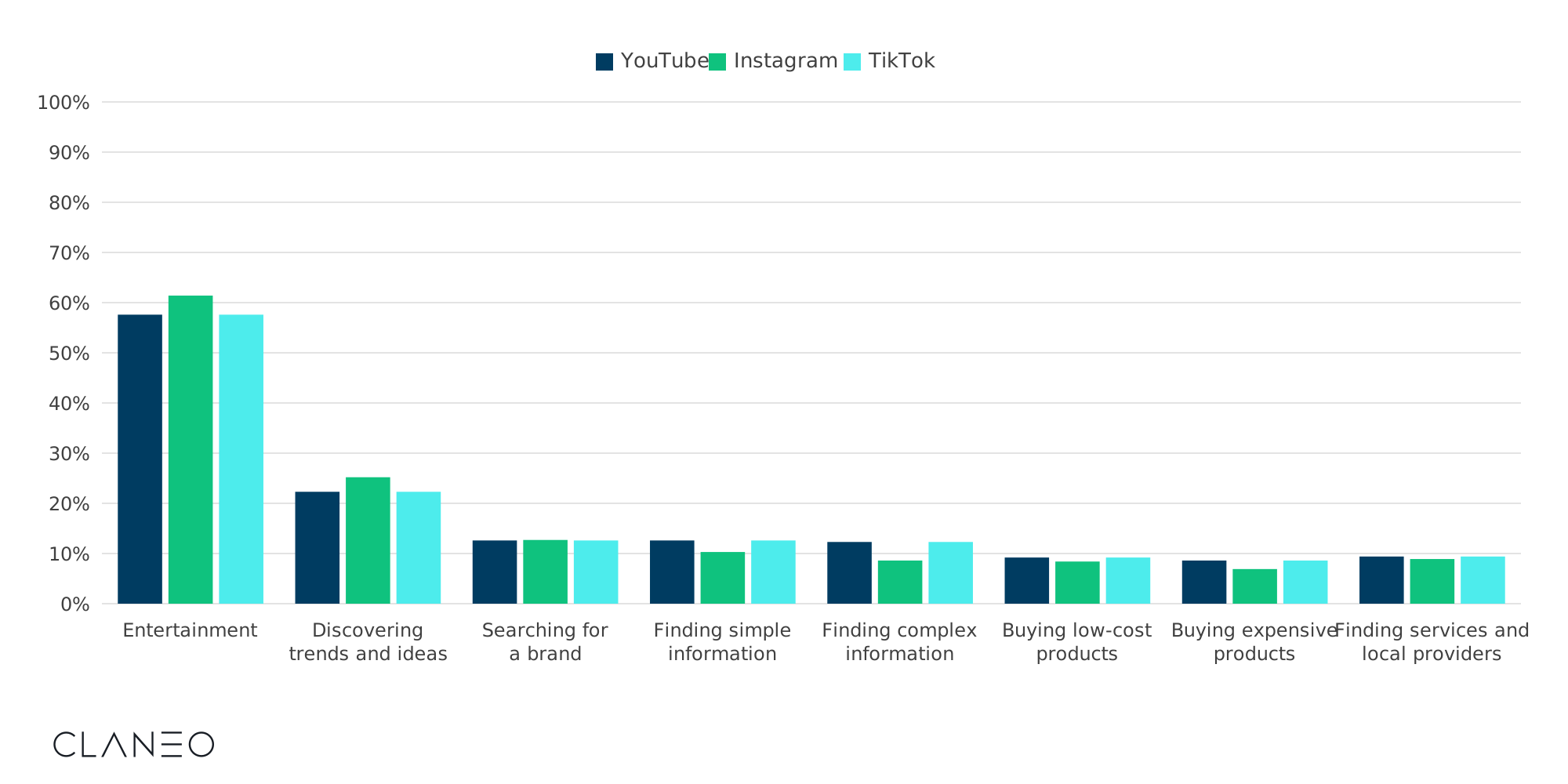
Social media remains an important part of everyday digital life: YouTube (67%), Instagram (65%, +15% year over year) and Facebook (51%) are used frequently, but primarily for entertainment (over 55% for YouTube, Instagram and TikTok).
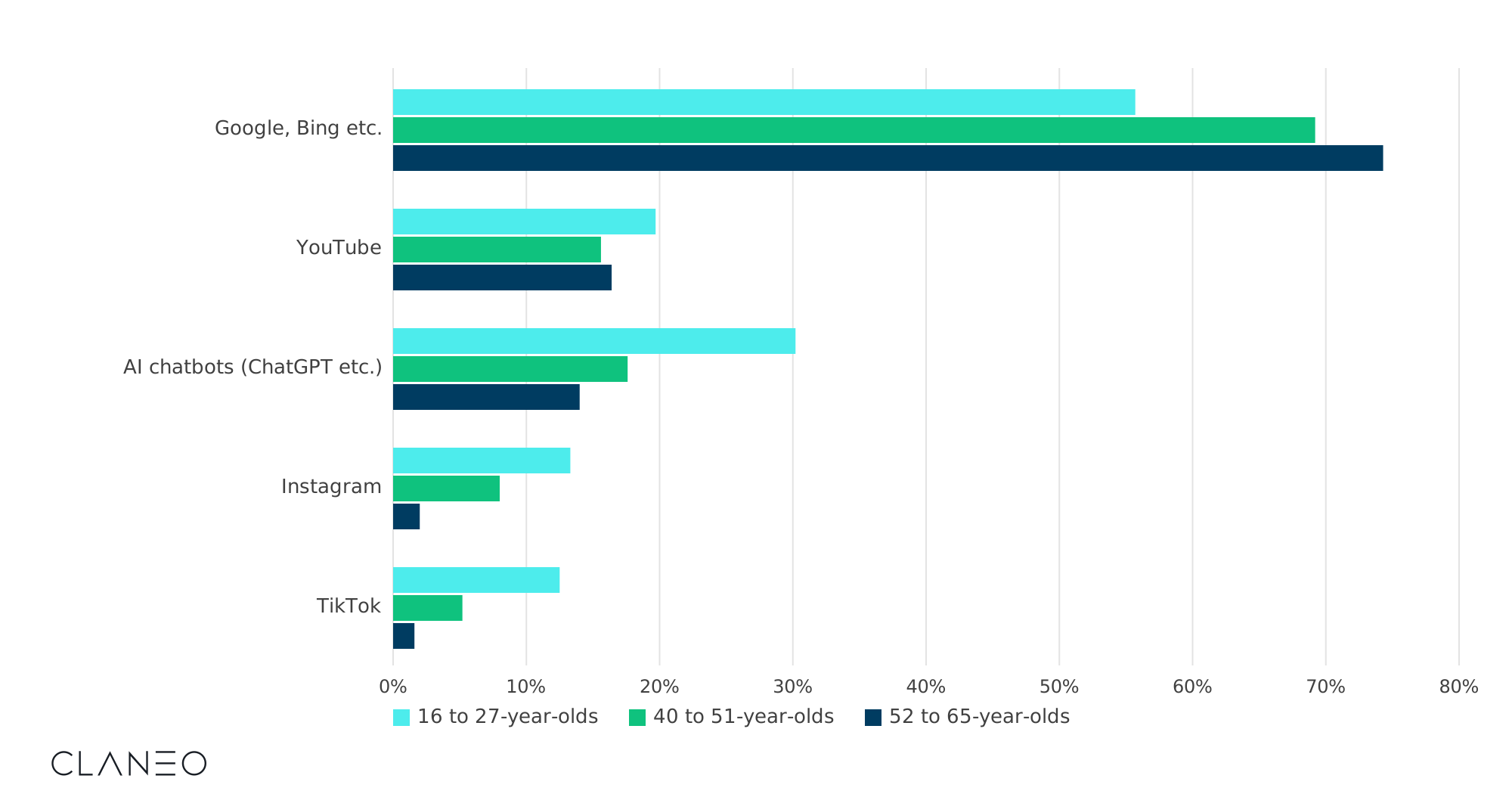
Usage differs clearly by age: among 16 to 27-year-olds, Instagram even ranks ahead of Google in frequency of use. This group also uses AI chatbots for information search much more often than older users.
In an international comparison, 77% of people in Germany use search engines several times a week (US: 72%), while AI chatbots are used more often in the US (25% vs. 17% in Germany).
Platform use several times a week (Germany)
| Platforms | Total | 16 to 27 | 28 to 39 | 40 to 51 | 52 to 99 |
|---|---|---|---|---|---|
| Search engines like Google, Bing, Yahoo! etc. | 77% | 73% | 79% | 82% | 75% |
| Price comparison like Check24, Idealo, mydealz etc. | 19% | 18% | 25% | 16% | 16% |
| AI chatbots like ChatGPT, DeepSeek, Gemini etc. | 33% | 47% | 38% | 29% | 18% |
| AI search engines like Perplexity, you.com etc. | 17% | 22% | 21% | 15% | 11% |
| Asian e-commerce platforms like Alibaba, Shein, Temu etc. | 14% | 21% | 16% | 10% | 11% |
| Microblogging platforms like X (Twitter), Mastodon, Bluesky Social etc. | 25% | 30% | 29% | 22% | 18% |
| Amazon online store | 33% | 30% | 38% | 32% | 32% |
| eBay | 23% | 24% | 25% | 21% | 20% |
| YouTube | 67% | 72% | 74% | 67% | 55% |
| 65% | 76% | 72% | 63% | 47% | |
| TikTok | 44% | 61% | 45% | 41% | 29% |
| 51% | 31% | 57% | 62% | 55% | |
| 14% | 22% | 16% | 12% | 6% | |
| 24% | 33% | 23% | 18% | 19% |
Share of each age group in percent that uses the respective platform several times a week. Source: Claneo State of Search Study 2025

Search behavior is becoming more specialized
Specialization in information search: simple vs. complex
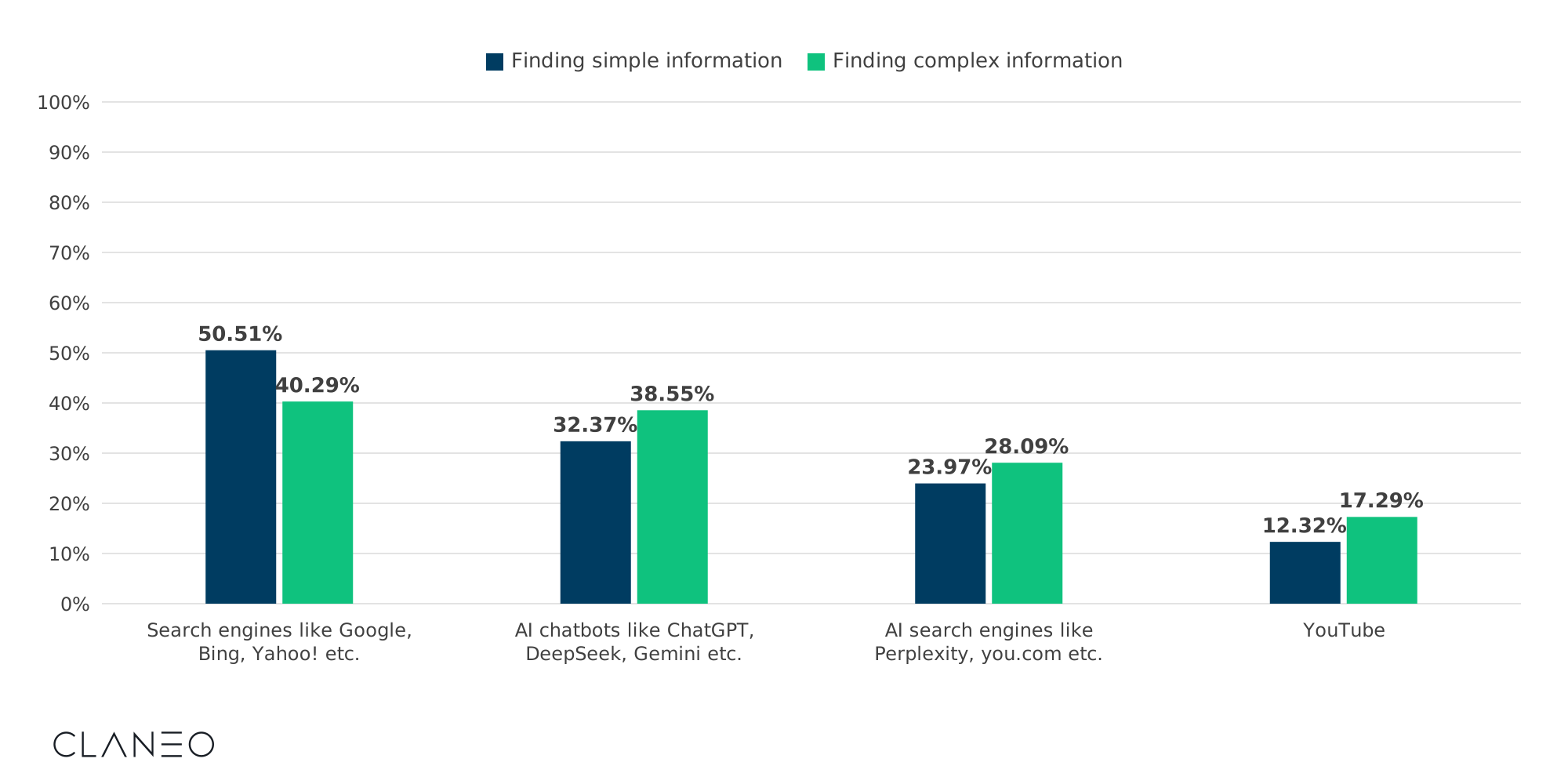
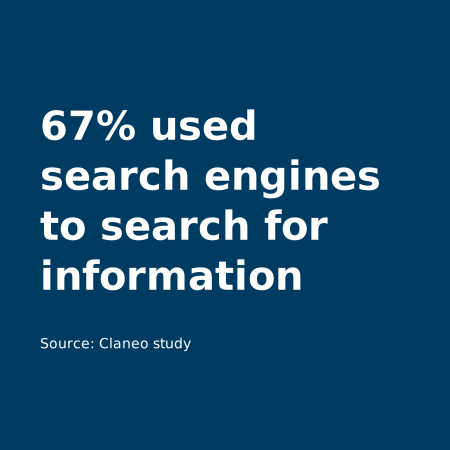
For information search, Google remains the first port of call at 67%, but AI chatbots are the big winners: their share rose from 13% (2024) to 21% (2025). AI solutions are catching up especially for complex information: Google is at 40.29% here, while AI chatbots already reach 38.55% and AI search engines 28.09%. Google continues to dominate for simple information (50.51%).
What do you mainly use these platforms for?
Specialization and generational differences in product search
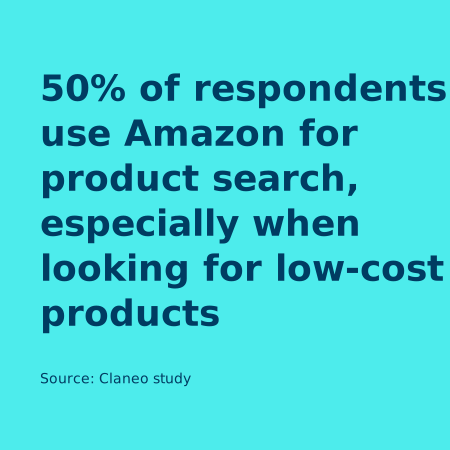
Product search is led by Google (53%) and Amazon (50%), followed by price comparison sites (27%). Interestingly, Amazon’s use for inexpensive products fell from 63% to 58%, while for expensive products it grew from under 9% to 19%, now on par with price comparison sites (18%).
Product search shows generational differences: although Google (48%) and Amazon (43%) still rank first and second among younger users (16 to 27 years), social media is catching up. Younger users turn to Instagram (17% vs. a 10% average across all age groups) and TikTok (19% vs. 9%) almost twice as often as average.
Young people rely more on social media and AI chatbots for information search (Where do you search for information online?)
What do you use social media for?
For entertainment and trends, social media is still ahead (Instagram: 62%, TikTok: 58%, YouTube: 64%).
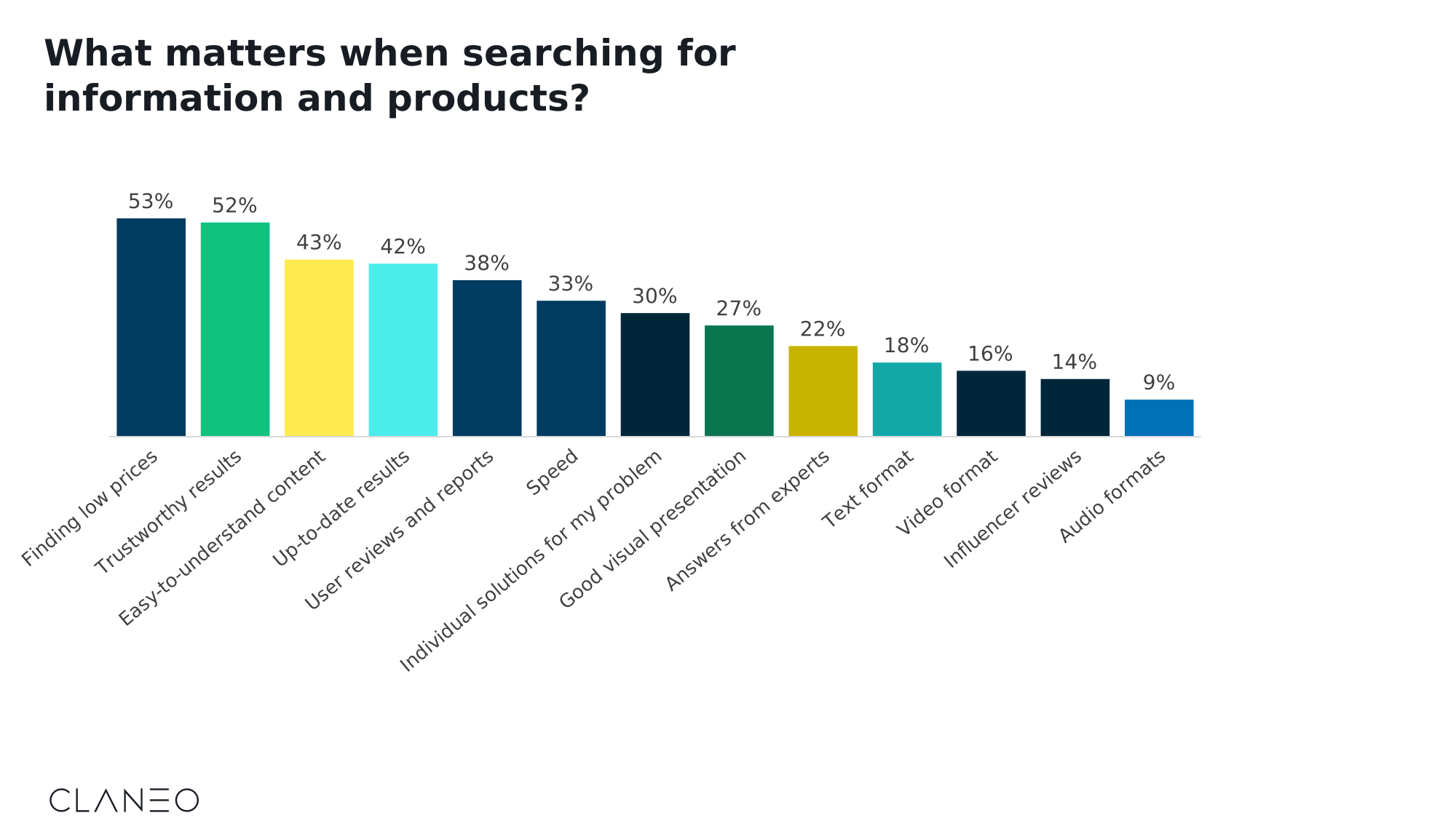
Online search has to be trustworthy, easy to understand and up to date
What do users expect from search results? Finding low prices comes first, closely followed by trustworthiness. Up-to-date information and easy-to-understand content take the next spots. User reviews and fast load times also remain important factors, so social proof is still highly relevant, while visual elements are secondary (visual presentation in 8th place, video formats in 11th).
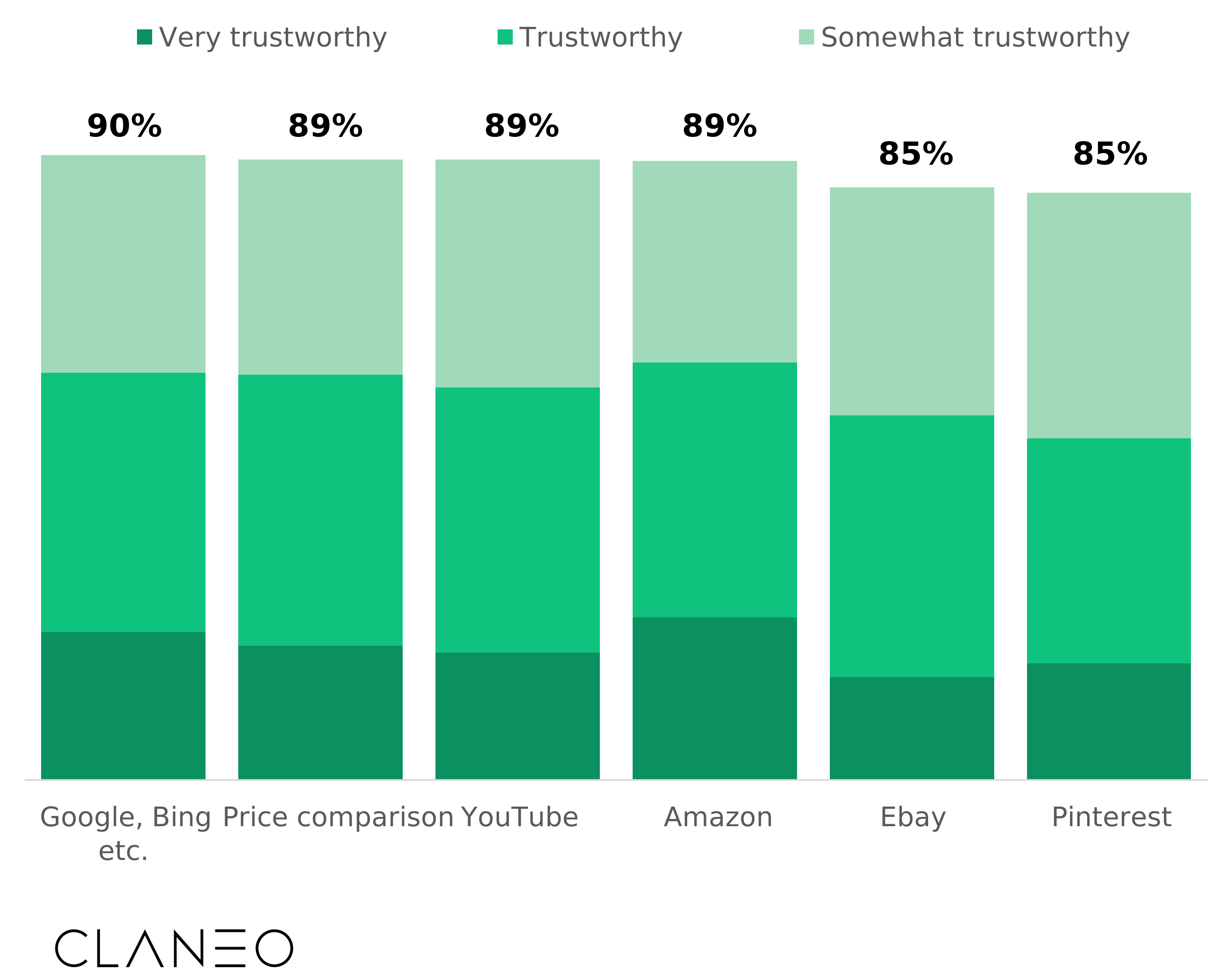
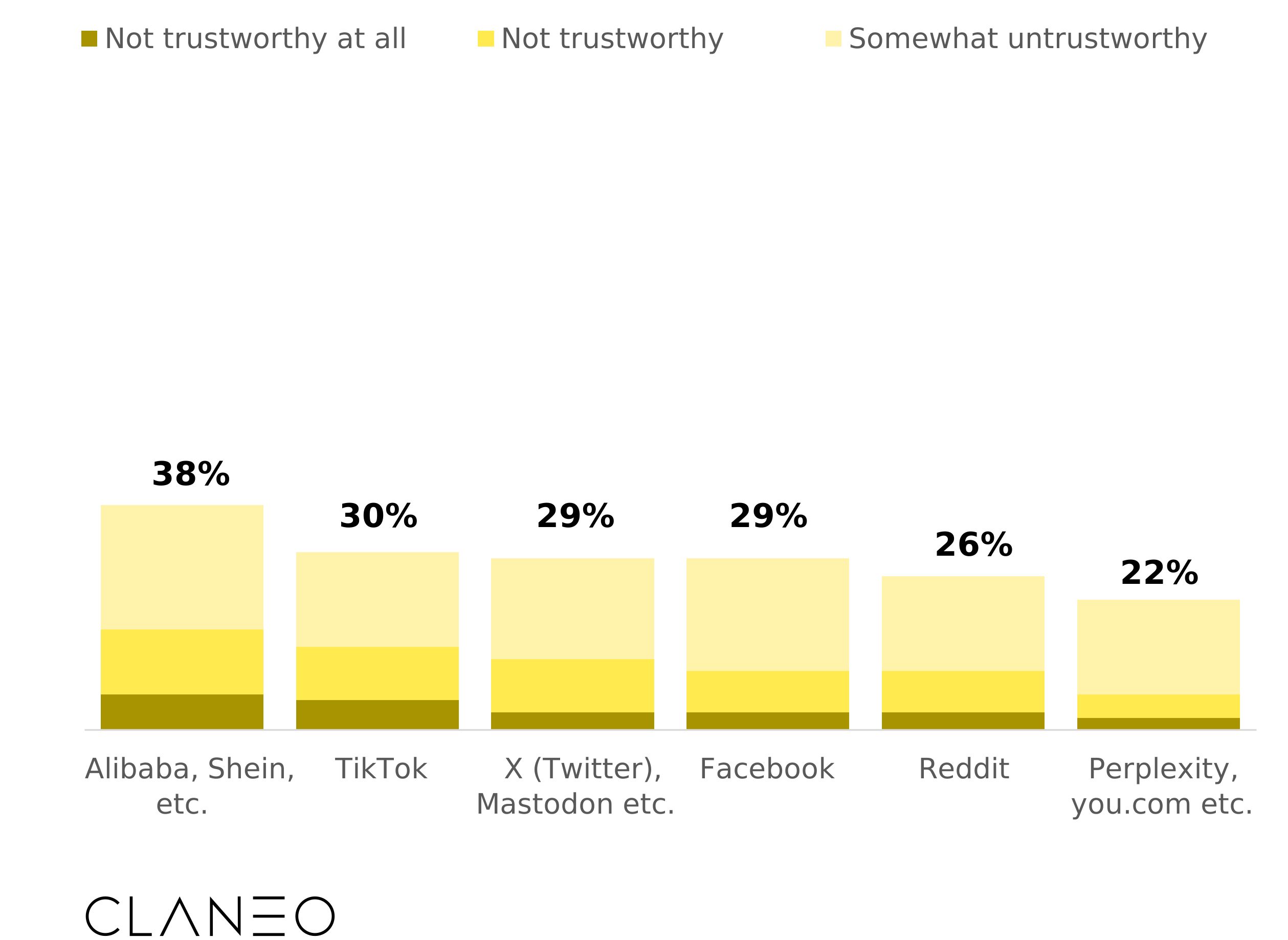
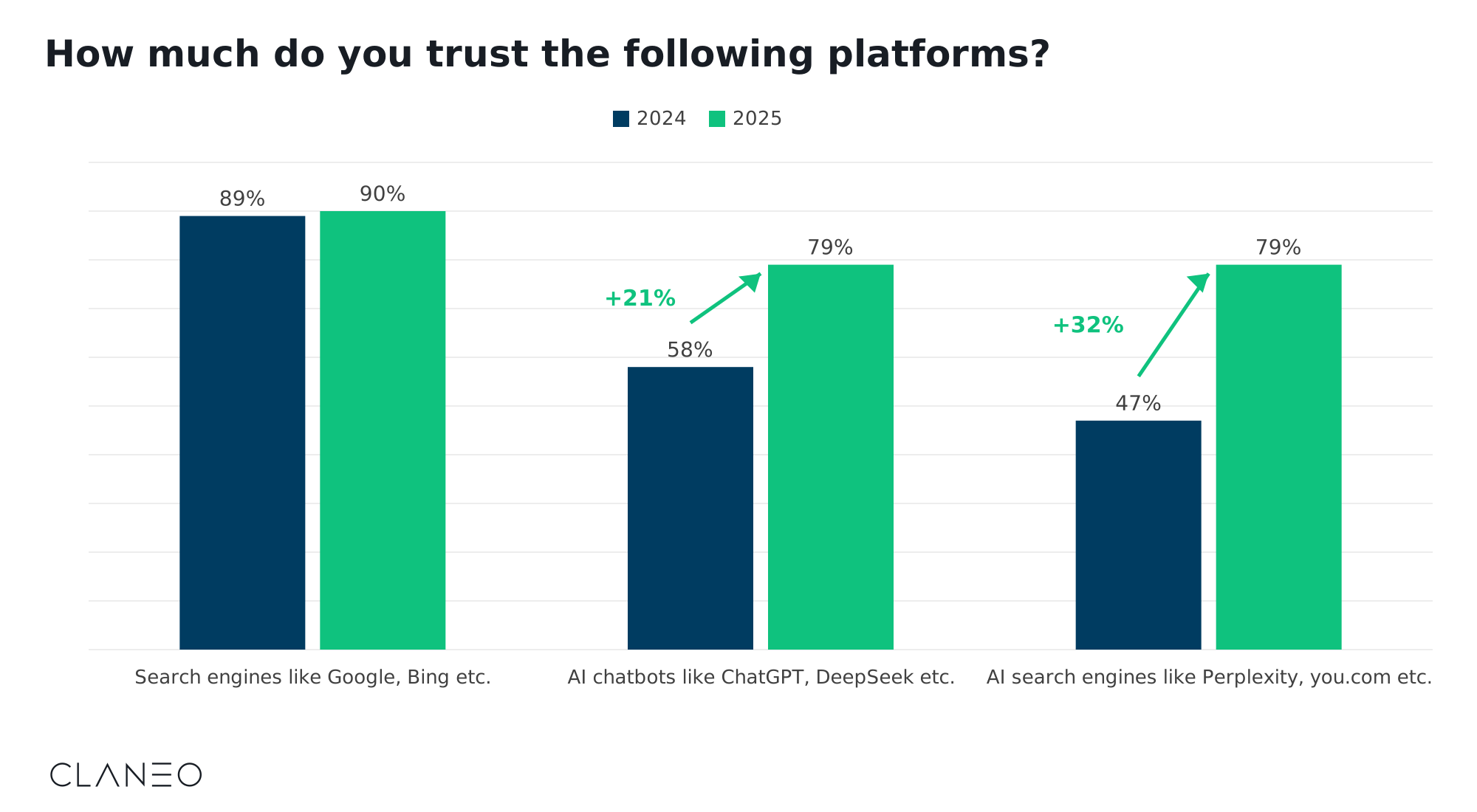
Trust in digital platforms has risen significantly: search engines, Amazon, YouTube and price comparison sites enjoy the highest trust at 89%. The increase in trust in AI platforms is remarkable: AI chatbots and AI search engines each reach 79%, up 21 and 32 percentage points respectively. Even TikTok raised its trust level from 48% to 71%.
Trust in online platforms
Search behavior by topic: What are the different platforms used for?
The choice of search platform depends heavily on the topic. Our study shows that users deliberately switch between platforms depending on what they are looking for. Clear preferences emerge for certain topic areas.
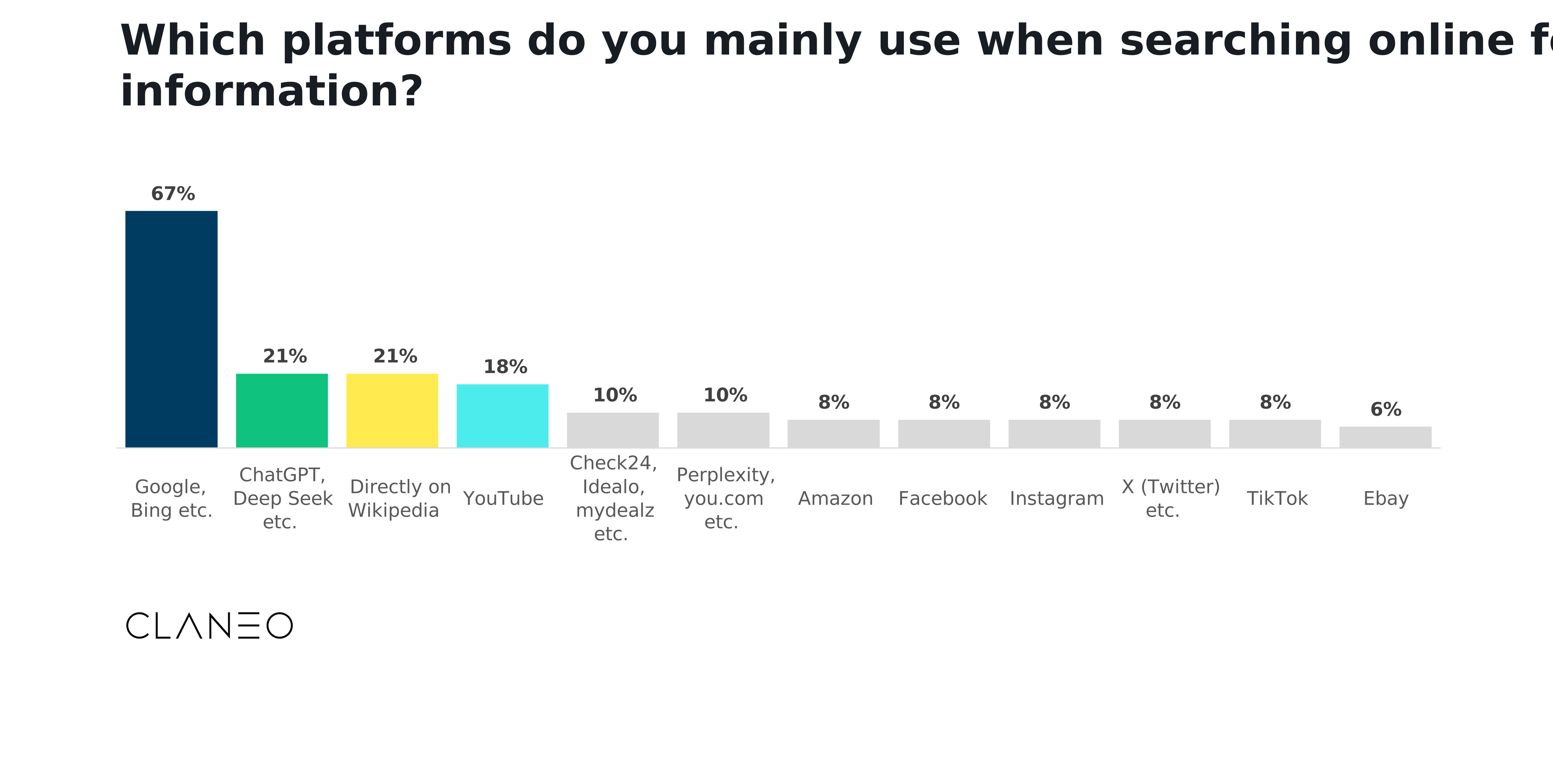
Search engines dominate at 67%, followed by AI chatbots (20%) and AI search engines (10%). Google leads for simple information (50.51%), while for complex topics AI chatbots (38.55%) are nearly on par with Google (40.29%). Interestingly, AI is used more often privately than at work.
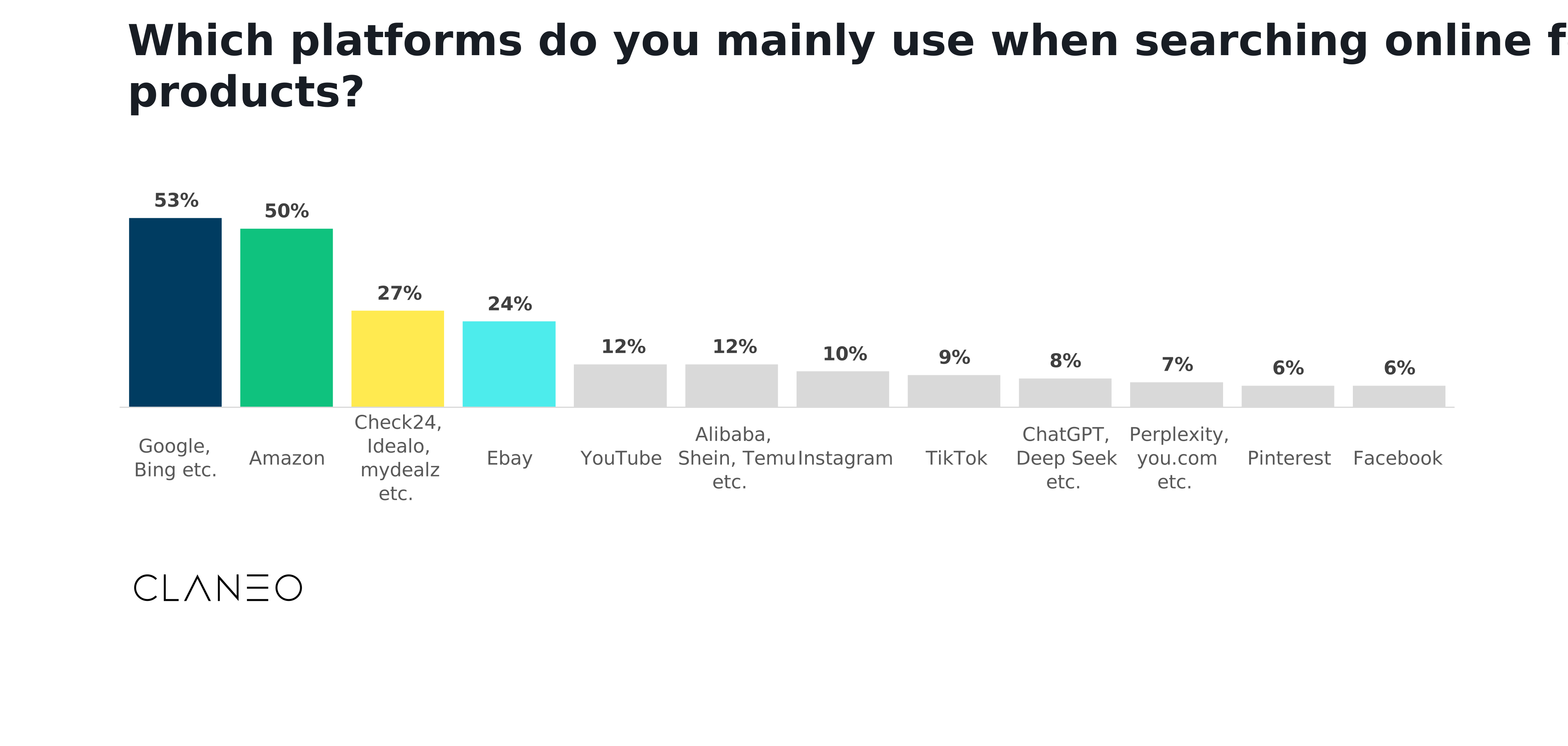
Google (53%) and Amazon (50%) lead, followed by price comparison sites and eBay. The younger generation increasingly uses Instagram (17%) and TikTok (19%) for product research.
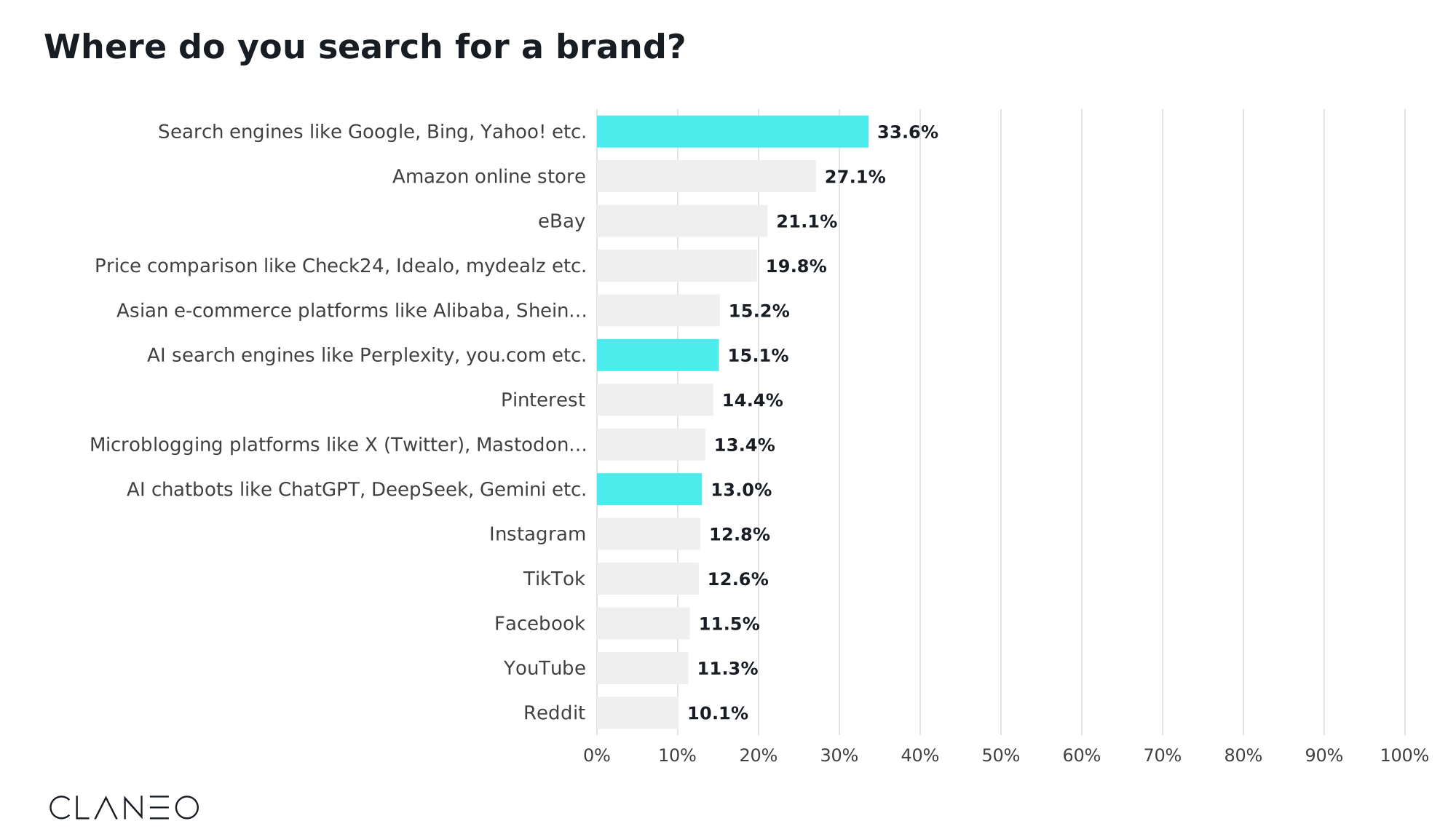
Search engines (34%) and Amazon (27%) are the first ports of call when searching for specific brands. AI platforms play a growing but still minor role at 13 to 15%.
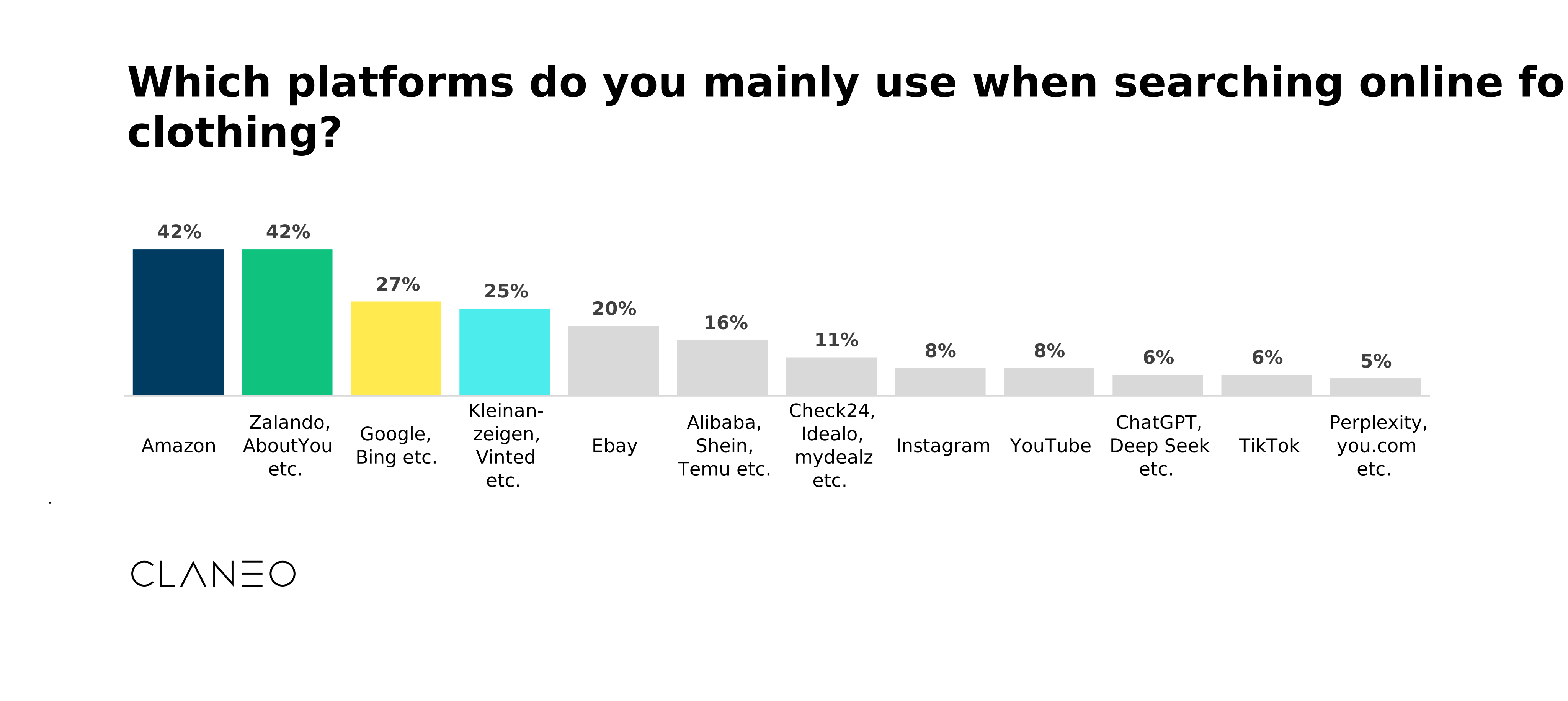
Amazon and fashion platforms like Zalando/AboutYou share first place at 42% each. Google follows at 27%, closely followed by secondhand platforms (25%), a sign of growing sustainability awareness.
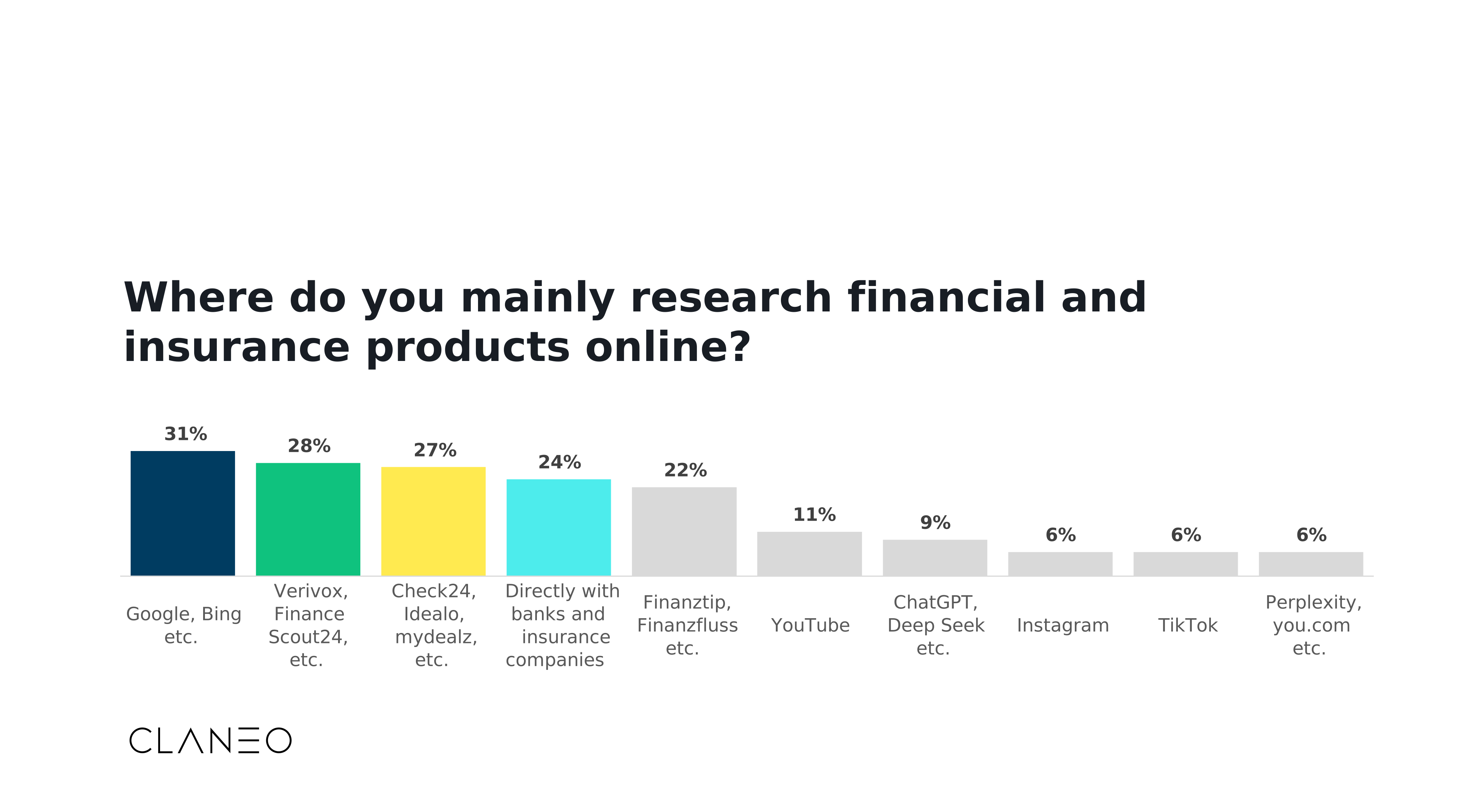
Google (31%) ranks ahead of comparison portals like FinanceScout24 (28%) and Check24/Idealo (27%). Direct provider sites of banks and insurers reach 24%, as trust plays a special role here.
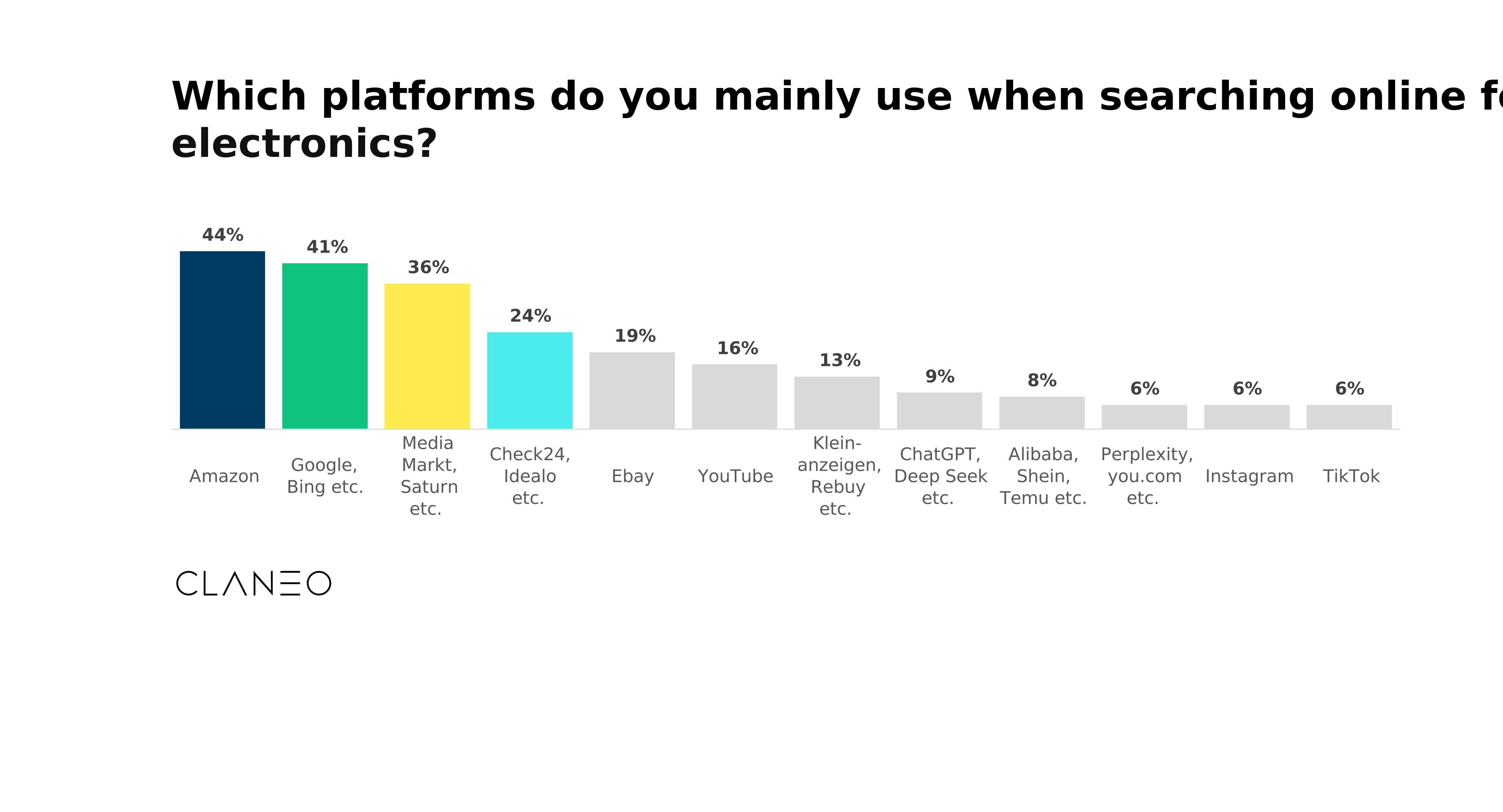
Amazon leads with 44%, just ahead of Google (41%). Specialized electronics platforms like MediaMarkt/Saturn follow at 36%, as expertise is valued for complex products.
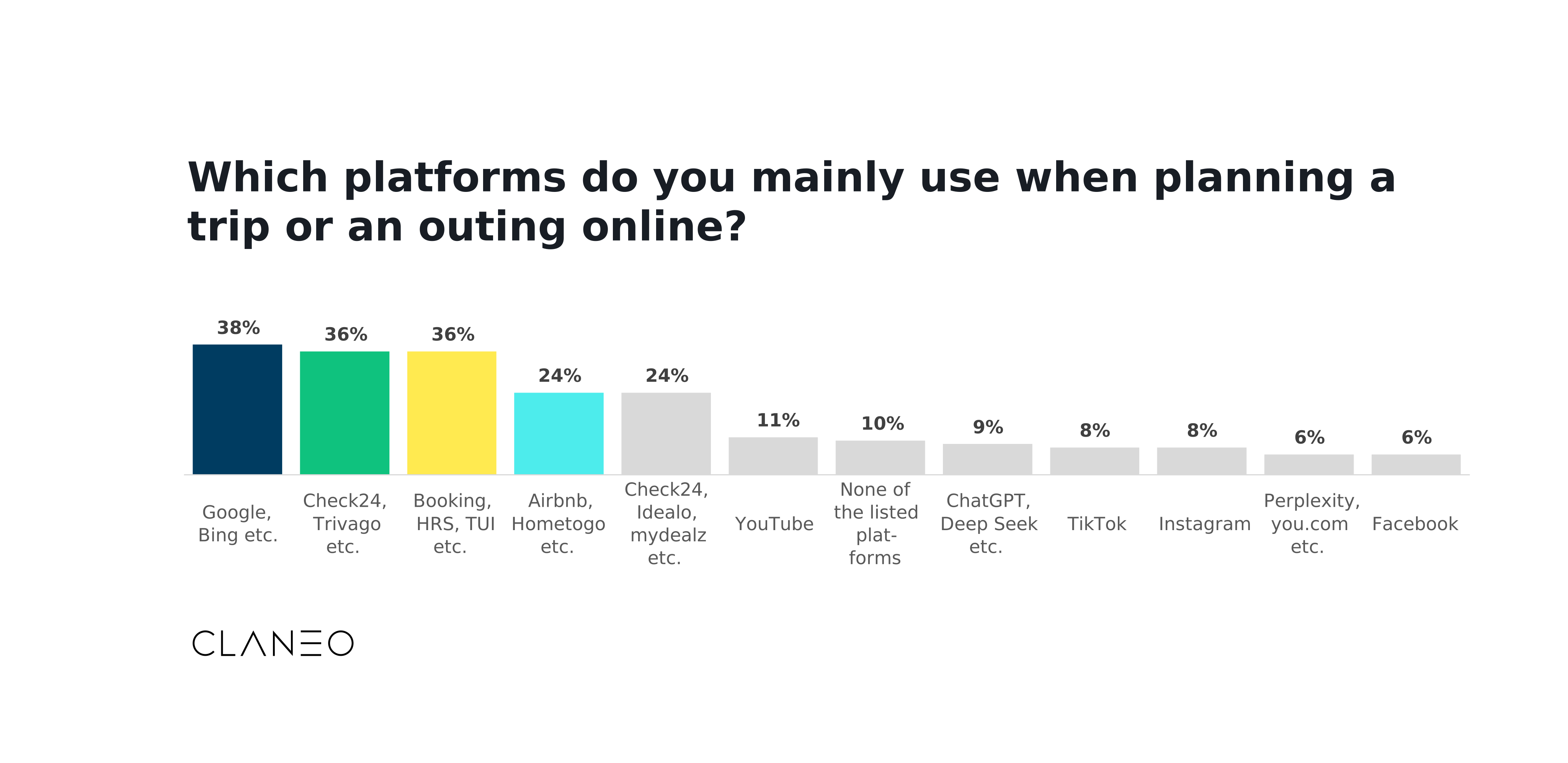
A balanced picture: search engines (38%), travel comparison sites (36%) and online booking platforms (36%) are almost level, as price comparisons are especially important in this industry.
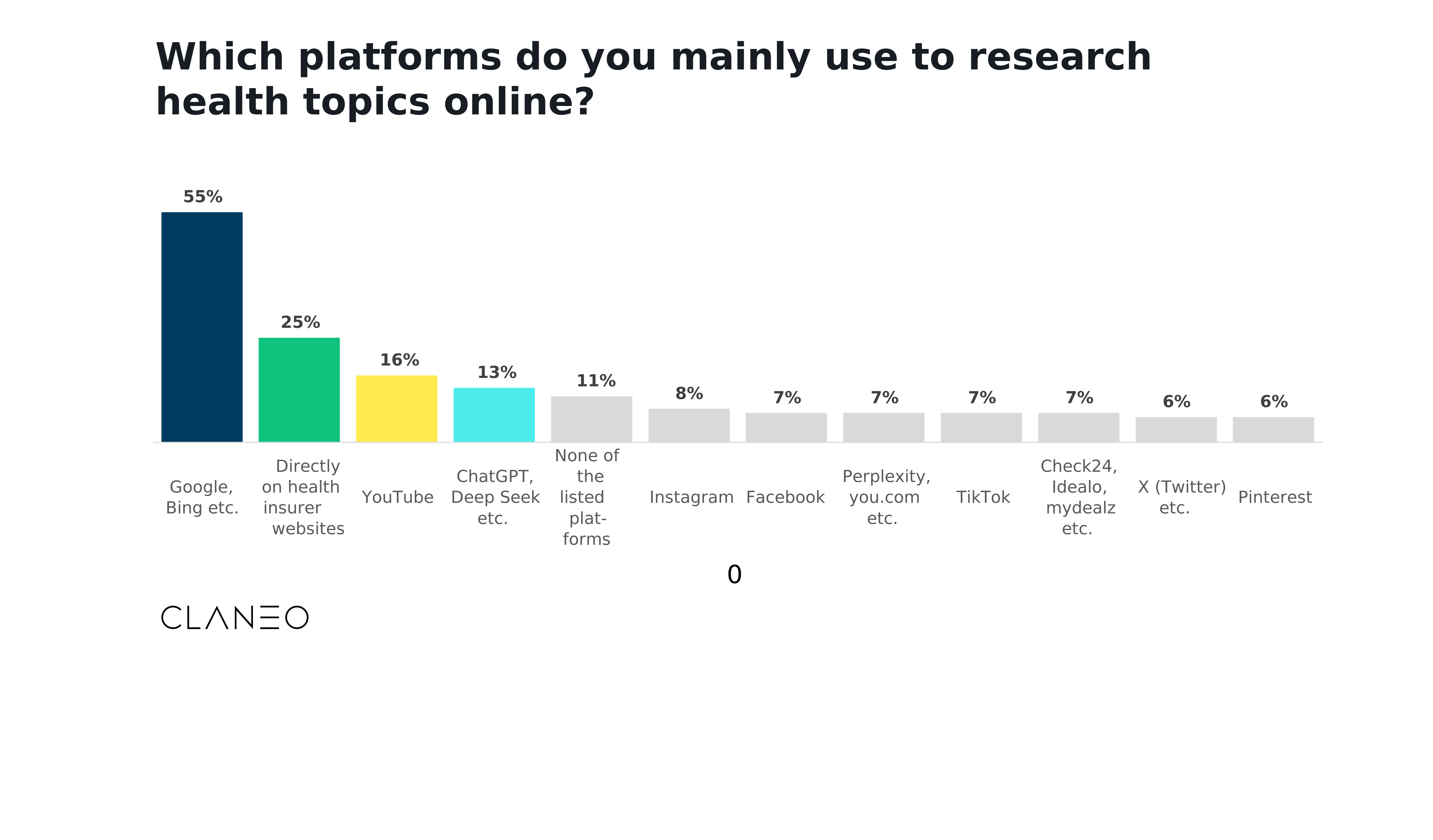
Search engines dominate at 55%, followed by health insurer websites (25%). Among the youngest generation, AI chatbots already rank second at 22%, a sign of future developments.
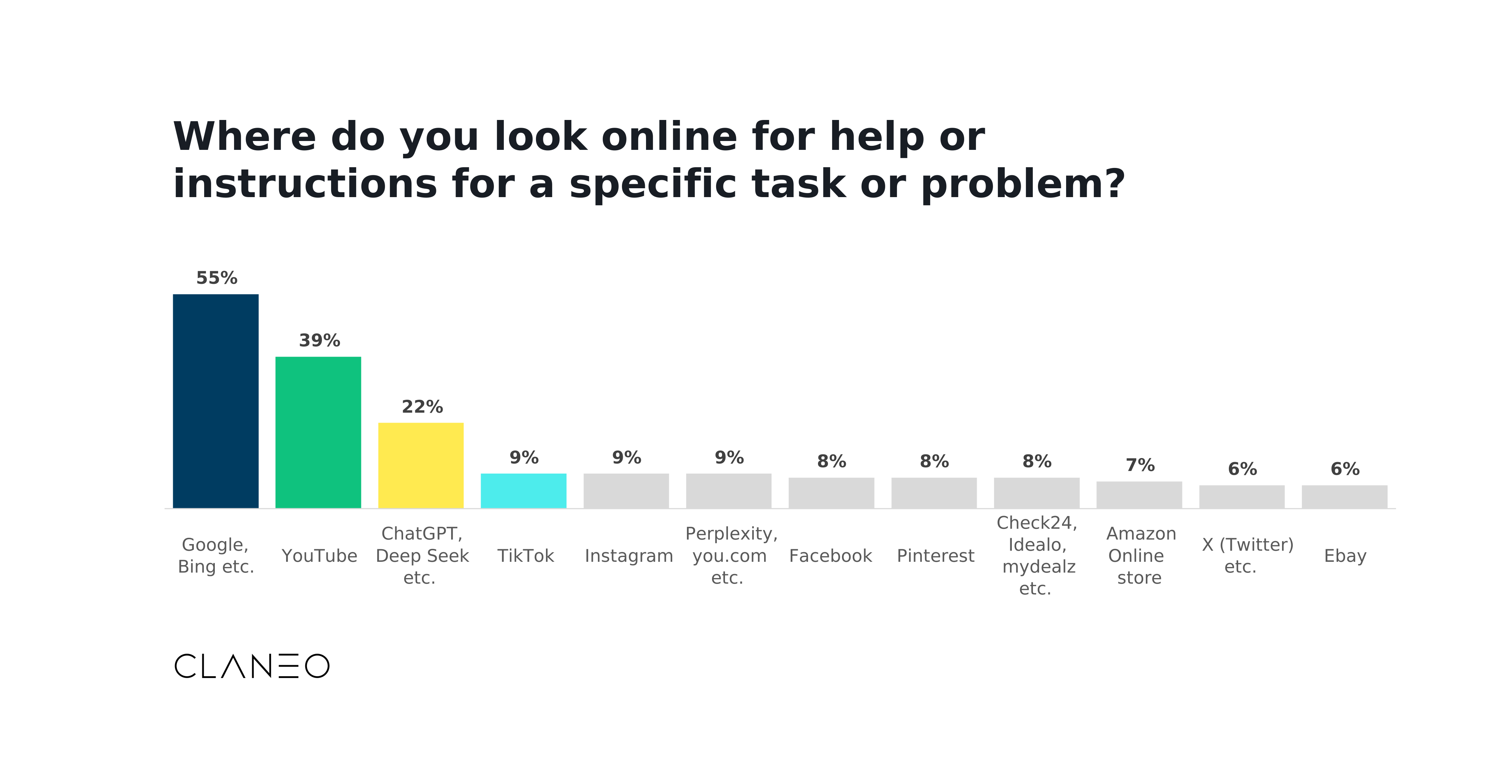
Search engines (55%) and YouTube (39%) are the preferred sources. AI chatbots follow at 22%, with usage evenly distributed across all age groups.
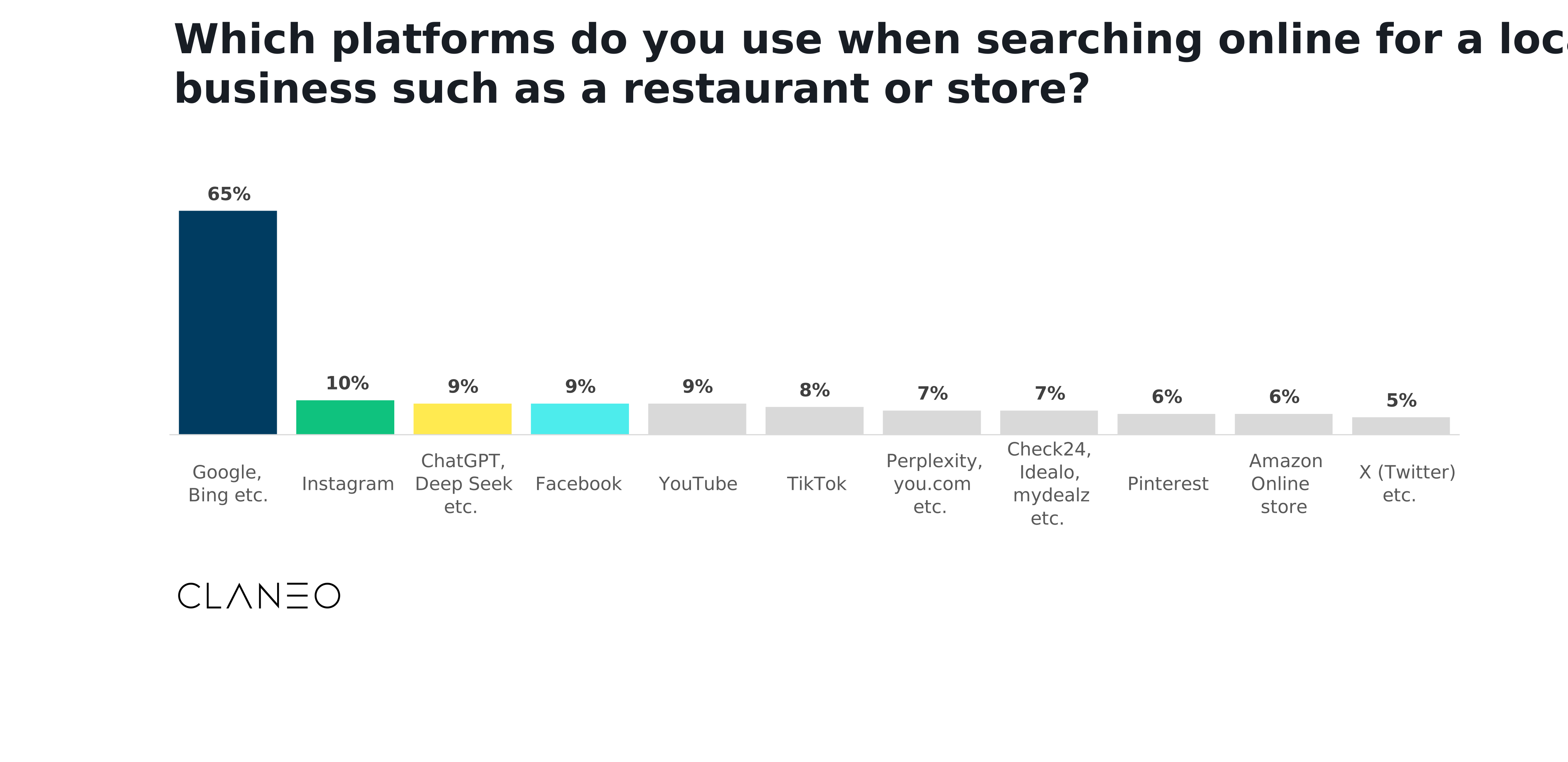
People search for restaurants or stores mainly via search engines (65%). Instagram follows at 10%, so local search remains the domain of traditional search engines.
AI use: more than just search
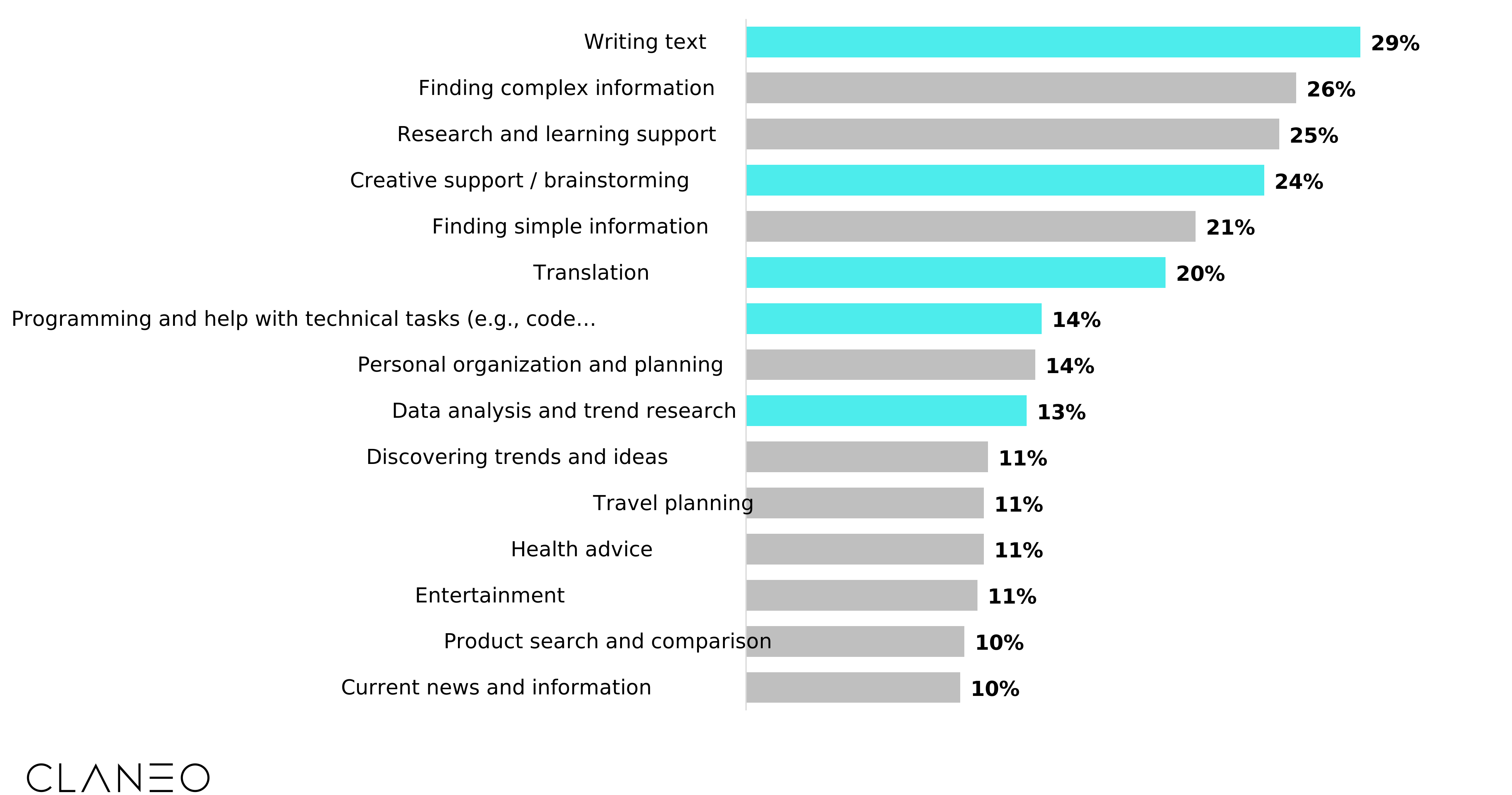
AI chatbots have become versatile tools that go far beyond traditional search. Text creation comes first at 29%, from writing emails to revising documents. AI assistants are also strong for complex information (26%) and research (25%). Creative support and brainstorming follow at 24%, while simple information search reaches 21%.
Notably, typical search functions such as product comparisons or current news sit at the bottom of the usage scale at only 10% each. This clearly shows that AI tools are valued primarily as productivity aids and creative assistants.
What do you use AI for?
Conclusion: specialization instead of monopoly, the new reality of online search
Our survey delivered some fascinating insights. Search engines like Google are and remain the leaders in many topic areas, but search behavior is becoming increasingly differentiated. Google still dominates for simple information, while AI chatbots are nearly on par for complex topics.
Trust continues to play a central role, and here a remarkable trend emerges: trust in AI platforms has risen dramatically.
Platform choice is becoming increasingly specialized: many use Zalando for clothing, MediaMarkt/Saturn for electronics and dedicated booking portals for travel. At the same time, Amazon is gaining importance for expensive products, a sign of growing trust in the platform.
Generational differences remain visible but are smaller than expected. Younger users integrate social media and AI tools into their search strategy more naturally, yet they too rely on Google for targeted searches.
Online search is becoming increasingly diverse: depending on demographic characteristics and search intent, different platforms are preferred and deliberately chosen. For all searchers, however, the core need remains the same: finding the right information in the right place.

Methodology: how the data was collected
The survey was conducted on April 1 and 2, 2025 using the market research platform Appinio. A total of 2,000 people took part in a panel survey, 1,000 each from Germany and the US, with an exact gender split of 500 women and 500 men each.
To enable meaningful comparisons between age groups, we deliberately did not use a population-representative distribution. Instead, 250 qualified responses with an equal gender split were collected in each of the four defined age groups (16 to 27, 28 to 39, 40 to 51, 52 to 99).
The 2024 study design was optimized and some answer options were revised. As a result, certain results from 2024 and 2025 are not directly comparable. The full data set is available on request.

Digital PR
To help you get found on these platforms while becoming more independent of any single platform, we support you holistically in developing successful digital PR strategies. From the first brainstorming and ideation through content creation, including visual and technical production, to targeted seeding: you benefit from our expertise from numerous successful projects.

AI Search Optimization (LLMO / GEO)
Our latest study shows how important it is not only to be found in traditional search engines like Google, but now also to gain visibility in AI chatbots and AI search engines. We advise you on the relevant areas such as tech, content and brand building and tell you what matters now to get found in ChatGPT, Perplexity and others.


